Achievements and Highlights of the NUK SPROUT Project
The National University of Kaohsiung’s SPROUT Project continues its implementation under the theme “NUK Supports NEXT”, aligning with the initiative’s four major pillars and International Chapter. The following presents our current achievements and highlights related to various aspects of the SPROUT initiative for the year 2025:
I. Enhancing Teaching Innovation
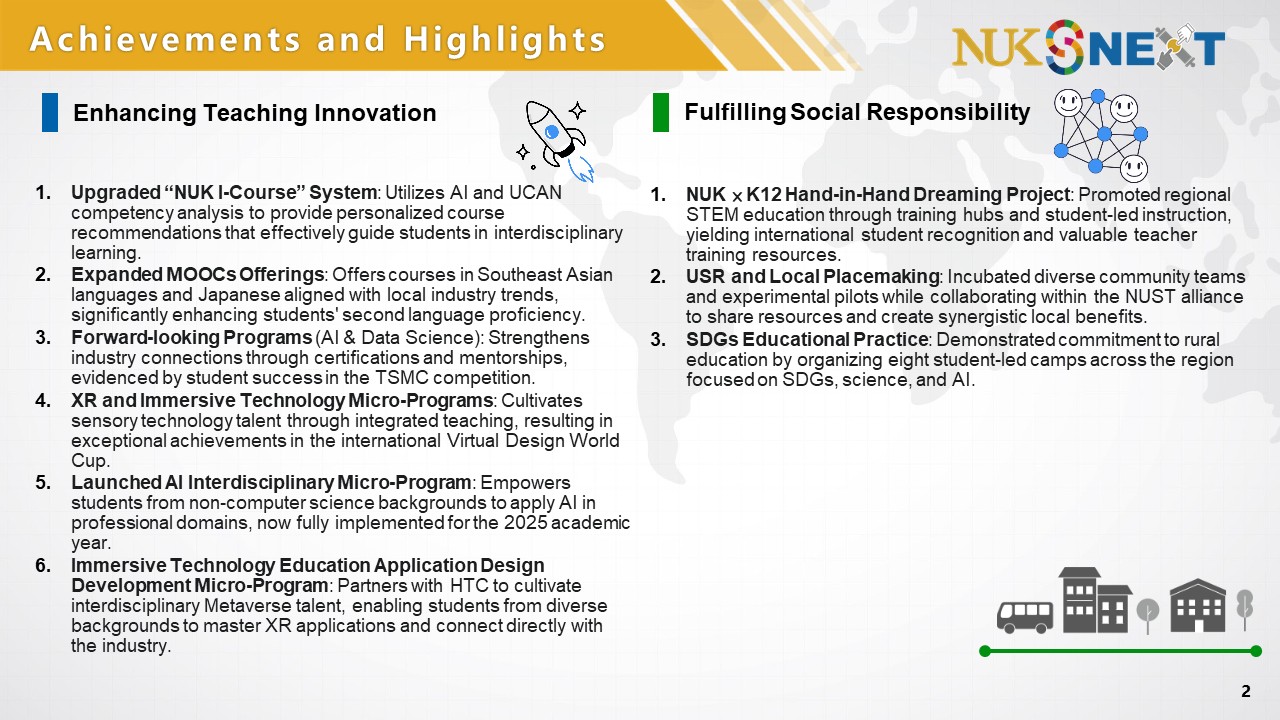
- Upgraded “NUK I-Course” System: Integrated students' academic records with UCAN competency analysis results, utilizing AI technology to provide precise, personalized course recommendations. Institutional research indicates that this mechanism effectively guides students in exploring interests and enhances motivation for interdisciplinary learning.
- Expanded MOOCs Offerings: Developed self-paced and MOOCs courses covering Southeast Asian languages and Japanese, aligned with local industry and tourism trends. These efforts support students in acquiring second foreign language skills and have significantly increased the visibility of on-campus online learning.
- Forward-looking Programs (AI & Data Science): Guided students to obtain EEC and Ministry of Economic Affairs iPAS certifications. Strengthened industry connections through mentorships and corporate visits. Notably, student teams won awards in the TSMC competition for creative system scheduling proposals, demonstrating strong practical capabilities.
- XR and Immersive Technology Micro-Programs: Dedicated to cultivating talent in sensory technology. The University hosted teacher workshops to integrate XR into teaching. Students achieved exceptional results in the “Virtual Design World Cup” (VDWC), with 43 students completing the micro-program certification, successfully bridging the gap between learning and application.
- Launched AI Interdisciplinary Micro-Program: Designed to empower students from non-computer science backgrounds to apply AI in solving professional domain problems. Following a successful pilot period recognized for curriculum excellence, the program is fully implemented for the 2025 academic year.
- Immersive Technology Education Application Design Development Micro-Program: Collaborated with tech giant HTC to cultivate interdisciplinary Metaverse talent. By establishing training directions through industry-academia collaboration and introducing industry mentors and corporate visits, the program enables students to seamlessly connect with the industry. The curriculum attracted students from diverse backgrounds, such as Law and Management, successfully fostering integrative talent equipped with capabilities in XR application and interaction design.
II. Fulfilling Social Responsibility
- NUK × K12 Hand-in-Hand Dreaming Project: Promoted regional STEM education by establishing two autonomous vehicle training hubs and developing three course modules. Supported robotics and science competitions and trained university students as instructors. Achievements include one team receiving youth innovation subsidies and one student selected for the “Youth Overseas Dream Fund” to visit Germany. Produced 46 high-quality physics educational videos for nationwide teacher training.
- USR and Local Placemaking: The USR Hub incubated three major teams: “Jianye New Village” (military dependents' village culture), “LOHAS NUK” (elderly health), and “Net Zero Green Campus” (ecological restoration). NUK also participated in the National University System of Taiwan (NUST) alliance to share resources and research with partner universities, creating synergistic benefits. USR Experimental Solutions: Supported 6 pilot groups in 2025, including community health workshops (Pickleball and Inline Skating), career initiatives for new immigrants, and intergenerational English learning projects.
- SDGs Educational Practice: Encouraged student clubs to organize camps in rural areas. In 2025, 8 camps were held across Kaohsiung, Pingtung, and Orchid Island (Lanyu), covering topics such as SDGs, biochemical materials, and AI, demonstrating the University’s commitment to rural education.
III. Strengthening Academia-Industry Collaboration
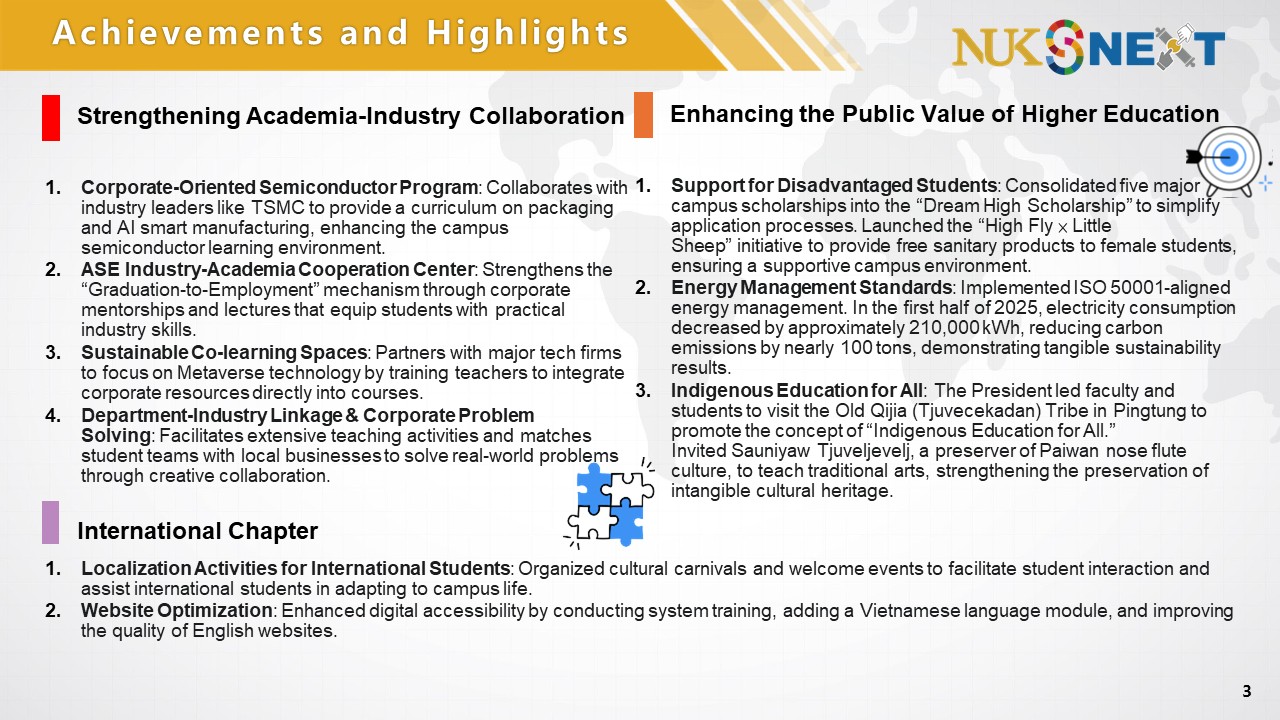
- Corporate-Oriented Semiconductor Program: Launched in September 2025, collaborating with industry leaders such as TSMC, Zhen Ding Technology, and OSE. The curriculum covers packaging and AI smart manufacturing, enhancing the semiconductor learning atmosphere on campus.
- ASE Industry-Academia Cooperation Center: Strengthened the “Graduation-to-Employment” mechanism. Through corporate mentorship and industry trend lectures (focusing on green manufacturing and automation), students gained practical skills and up-to-date knowledge.
- Sustainable Co-learning Spaces: Signed MOUs with Far EasTone, ASUS Cloud, and Chunghwa Telecom to focus on Metaverse technology. In 2025, three seed teachers were trained to integrate corporate resources into courses, deepening the industry-academia link.
- Department-Industry Linkage & Corporate Problem Solving: Facilitated 111 teaching activities across 8 departments. The “Corporate Problem Solving” initiative matched 5 student teams with local businesses. Notable projects included interactive designs for the Ciaotou Sugar Refinery (participating in the Pinkoi Design Festival) and visual identity designs for Le Qun Village.
IV. Enhancing the Public Value of Higher Education
- Support for Disadvantaged Students: Consolidated five major campus scholarships into the “Dream High Scholarship” to simplify application processes. Launched the “High Fly × Little Sheep” initiative to provide free sanitary products to female students, ensuring a supportive campus environment.
- Energy Management Standards: Implemented ISO 50001-aligned energy management. In the first half of 2025, electricity consumption decreased by approximately 210,000 kWh, reducing carbon emissions by nearly 100 tons, demonstrating tangible sustainability results.
- Indigenous Education for All: The President led faculty and students to visit the Old Qijia (Tjuvecekadan) Tribe in Pingtung to promote the concept of “Indigenous Education for All.” Invited Sauniyaw Tjuveljevelj, a preserver of Paiwan nose flute culture, to teach traditional arts, strengthening the preservation of intangible cultural heritage.
V. International Chapter
- Localization Activities for International Students: Organized the “Southern Country Culture Carnival” featuring Indonesian and Vietnamese cuisine to facilitate interaction between local and international students. Hosted welcome events for the International Foundation Program to assist students in adapting to campus life.
- Website Optimization: Conducted online training for the “R-page 2.0 Accessible Website Management System.” Successfully added a Vietnamese language module (pending public launch) and encouraged administrative units to improve English website quality and accessibility.
Sprout Project Achievements Website: https://wish.nuk.edu.tw/main/index