Strategic Reform Initiative: Local Practice and International Linkage — The Local, International, and Experimental FGU
Fo Guang University (FGU), adhering to its motto of "Righteousness, Integrity, Truth, and Compassion," is dedicated to fostering humanistic innovation and fulfilling its University Social Responsibility (USR). As the university enters the second phase of the Higher Education Sprout Project (2025–2027), it aims to integrate resources from the Fo Guang Shan system, strategically reposition the institution, and cultivate distinct characteristics to ensure sustainable development. Following his inauguration in November 2024, President Han-Chieh Chao unveiled a new strategic directive centered on three pillars: "Local FGU," "International FGU," and "Experimental FGU." This vision underpins the "Strategic Reform Initiative for Local Practice and International Linkage," which serves as the core roadmap for the university's transformation over the next three years.
I. Teaching Innovation: Implementing Interdisciplinary Innovation and Comprehensive Quality Assurance
To modernize its academic infrastructure, FGU has evolved its educational framework into "Academic System 3.1," expanding the original three-dimensional focus into six core dimensions: Program-oriented, Practical, Employment-focused, Interdisciplinary, AI-integrated, and Self-directed. This comprehensive restructuring is designed to equip students with the resilience and competencies required for future challenges. A key component of this reform is the "16+2 Semester Plan," which introduces flexible scheduling to enhance autonomous learning and practical application. The efficacy of this model was demonstrated during the flexible teaching weeks of the Spring 2024 semester, where 117 students participated in intensive courses related to AI and the Sustainable Development Goals (SDGs), achieving a certification pass rate of 69.23%. Furthermore, the university is actively integrating Artificial Intelligence into residential college education through "AI Learning Companions" and has established a "Digital Learning Platform" and "Synchronous Multi-Language Translation Classrooms" to bolster distance education and international exchange.
Quantitative metrics reflect significant progress in interdisciplinary and autonomous learning. Between 2024 and 2025, the proportion of undergraduates completing interdisciplinary courses rose from 21.10% to 21.91%, while the completion rate for interdisciplinary credit programs surged from 4.03% to 18.00%. Faculty engagement has also intensified, with the percentage of instructors offering interdisciplinary courses increasing to 23.50%. In terms of curriculum design, modular course offerings grew to 8.41%, and the prevalence of Problem-Based Learning (PBL) and capstone courses rose to 44.55%. Additionally, the university successfully met its targets for general education courses featuring experiential and action research, reaching 71.14%, while simultaneously expanding assessment tools for self-directed learning.
II. University Social Responsibility: Deepening Professional Service and Comprehensive Engagement
FGU continues to deepen its social impact by leveraging the "Venerable Master Hsing Yun Digital Humanities Research Center" to promote international academic exchange in Buddhist digital humanities. On a local level, the university is strengthening the "Vegetarian Industry R&D Chain" and "Body-Mind-Spirit Health Management Modules" to foster industry development and enhance the well-being of Yilan residents. Through the implementation of "Local Practice" and "Social Engagement" course series, the completion rate for social engagement courses among students rose to 38.50% in the 2024-2025 period. Administratively, the university is planning a "Community Service Center" in collaboration with the Yilan County Government to train volunteers and advance "All-Age Flexible Learning" and long-term care talent cultivation. Concurrently, the "Southeast Asian Language and Cross-Cultural Talent Development Program" creates vital pipelines for cultural fluency and regional connection.
III. Industry-Academia Collaboration: Elevating Capacity and Value Addition
To bridge the gap between academia and industry, FGU has established an "Industry Leader Alliance" and a "Academic-Industry Dual-Mentor Employment Program," where faculty and industry experts co-teach to enhance students' practical workplace skills. This initiative is supported by a robust mechanism for internships, career lectures, and employment matching. The university is also pioneering experimental education by collaborating with local institutions in Yilan to explore new learning models. In parallel, FGU has constructed a comprehensive incubation network and entrepreneurship base, utilizing competition-driven training to foster entrepreneurial skills. These efforts have yielded tangible results in student employability; according to UCAN assessments, students' "Problem Solving" competency showed a net growth of 0.29% between 2024 and 2025, and the student internship participation rate achieved its target, rising to 8.83%.
IV. Public Nature of Higher Education: Strengthening Support and Sustainable Governance
FGU remains committed to equity and global connectivity. The "Blue Magpie Project" continues to provide critical support to economically and culturally disadvantaged students, achieving a 100% coverage rate for counseling services and resulting in a measurable academic performance improvement of 0.29 points in 2025. On the international front, the university has focused on "Buddhist Cultural Exchange" to attract global talent. This strategy has proven effective, with the number of inbound exchange students increasing from 1 to 12 over two years, and the proportion of dual-degree students rising to 0.27%. A major milestone in global recognition was achieved in November 2025, when FGU debuted in the QS Asia University Rankings 2026, ranking 38th in Taiwan and 318th in East Asia. Additionally, the university projects continued growth in core competencies such as "Continuous Learning" and "IT Application" through 2027, driven by its holistic and intergenerational learning initiatives.
Summary of Institutional Achievements
In recent years, Fo Guang University has demonstrated exceptional performance across teaching innovation, social responsibility, and sustainability. In the realm of teaching excellence, faculty members secured 12 grants from the MOE Teaching Practice Research Program in 2025, totaling nearly NT$3.14 million. Research quality is further evidenced by the university’s inclusion in the International VIP Consortium and its AD Scientific Index H-index ranking within the top 40 in Taiwan.
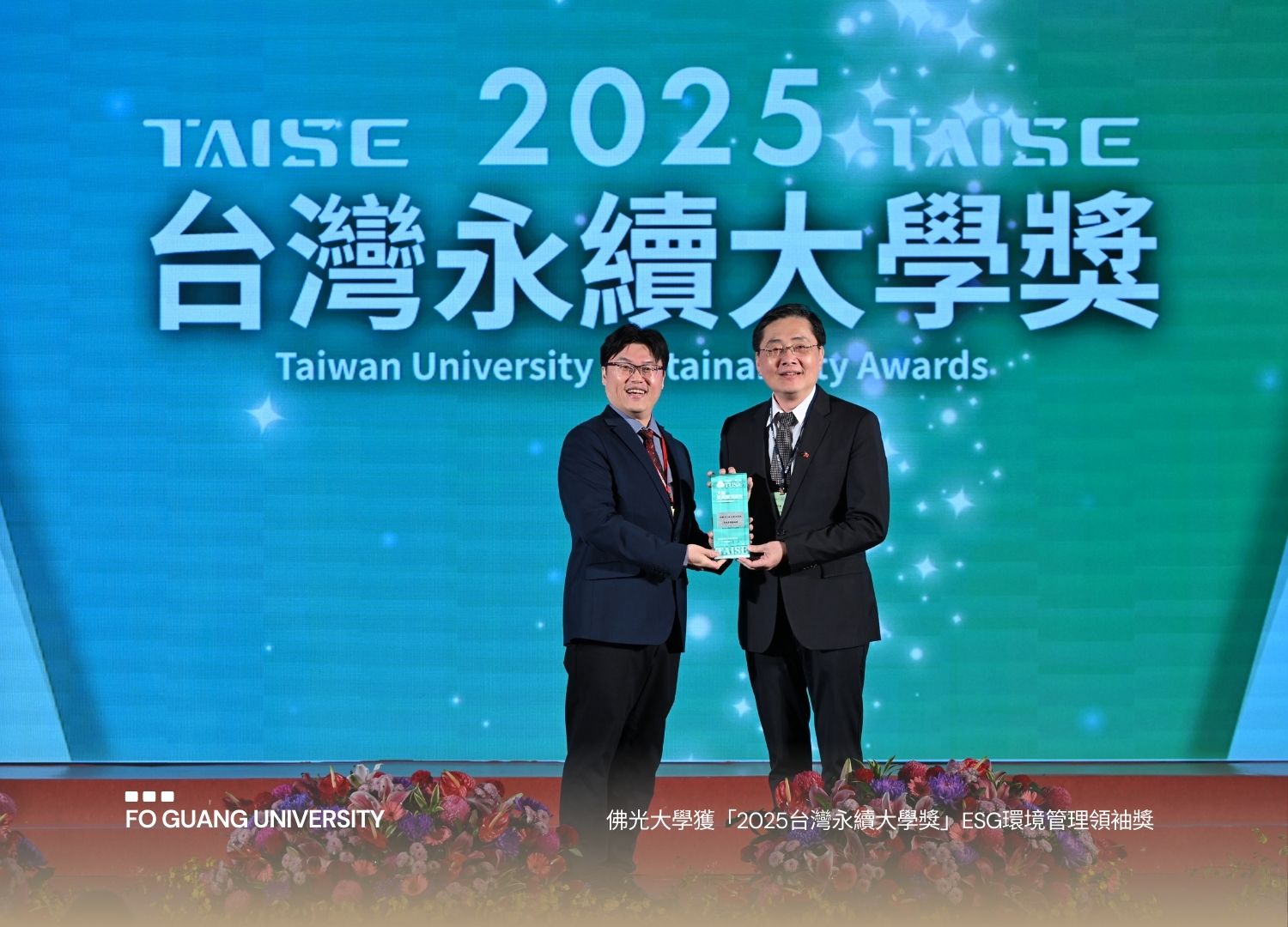
Regarding social responsibility, FGU has secured record-breaking funding of NT$23.25 million for three MOE USR projects and has been recognized as a Distinguished School for both Life Education and Character Education. The university’s commitment to sustainability was acknowledged with the "ESG Environmental Management Leadership Award" at the 2025 Taiwan Corporate Sustainability Awards. Finally, regarding international mobility, FGU leads Eastern Taiwan with over 470 overseas exchanges in the past three years, including 173 instances in 2024 alone, solidifying its status as an inclusive, internationalized institution.
【Fo Guang University Receives the 2025 Taiwan Sustainable University Award – ESG Environmental Management Leadership Award】
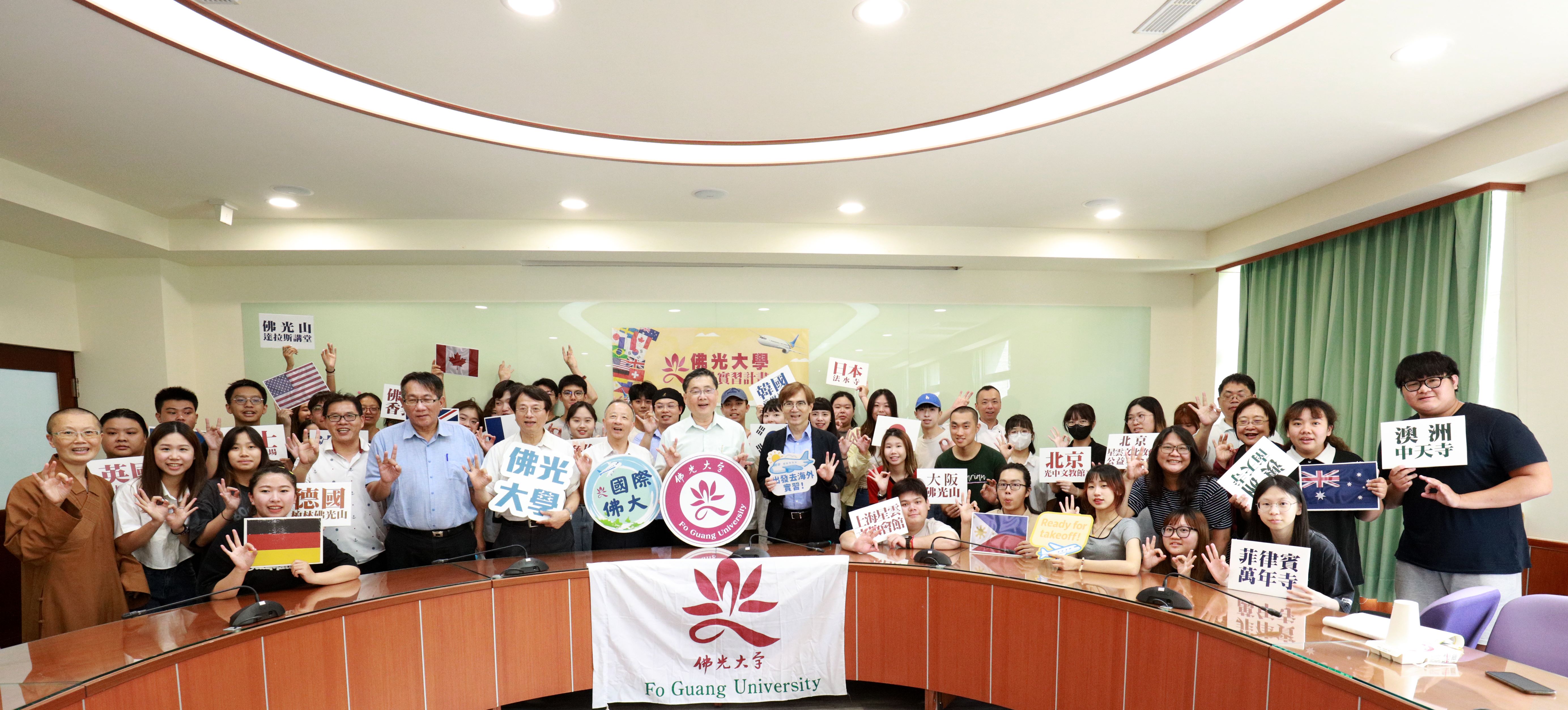
【2025 Ministry of Education “Learning in the World” Overseas Study Program Flag Presentation Ceremony】
【2025 University Career Expo】
